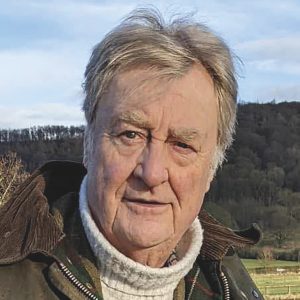
 Elke twee maanden wordt voor Kerknieuws iemand geïnterviewd die op de een of andere manier betrokken is bij de Nederlandse Kerk. Deze keer is een van onze lectoren Laurie West-Knights geïnterviewd. Sinds afgelopen maand is Laurie bovendien echtgenoot van onze laatste voorzitter van de kerkeraad Liesbeth Knook.
Where are you from and how did your road cross with the Dutch Church in London?
My parents were ‘Army’. My father fought in WWII and remained a career soldier all his working life. My mother came from Yorkshire, my father from an old family in East Anglia. We lived where the Army sent him – various places in Germany and, mostly, southern England. After University, I came to live in London where I qualified and then practised as a barrister. 35 years ago I met Liesbeth at night school; we were both learning Swedish. That is how I found her but not, then, the Dutch Church. We knew each other for a few happy months, but our paths diverged. We both married and had children, and there was no further contact until after those marriages came to an end, some 18 years later.
You are in many ways very British. You went to boarding school, you’re a Cambridge alumnus and grew up in the Anglican tradition. What can the Dutch Church learn from that Anglican tradition? And what did you learn from the Dutch way of doing things?
It sounds rather privileged; it wasn’t really. For Army families in those days, boarding school was a necessity to maintain continuity. The fees were paid directly by the Army. I was fortunate to have gone to an excellent, academic, senior school, and followed my great-Uncle Harold (1880-1972) to Emmanuel College, Cambridge. Prep school was attached to Ely Cathedral, and I sang in the Chapel at Emmanuel. Choral music was in the bones, as was traditional Anglicanism.
I am not sure what the Church of England as an institution could teach anyone, but at its best, and roots, Anglicanism is a very broad church and represents (to me) solid, traditional (old-fashioned) virtues such as honesty, respect and a sense of history, though the truth is that there are so many degrees of Anglicanism from neo-Catholic to ‘happy-clappy’. I was never at ease with either extreme. I found the Dutch Church in London very different – honest, of course, but liberal and modern, particularly in its attitudes to divorce and sexuality. Intellectual sometimes. Because of its ‘vluchtelingen’ origins the Nederlandse Kerk is inherently, instinctively more tolerant of incomers than many people who profess to be Anglican Christians. I have come to like and admire this more liberal tradition. The comparison, though, is slightly unfair: the 2 incumbents whom I have known – Joost Rὅselaers and Bertjan van de Lagemaat – are streets ahead of the average CofE vicar.
A lot of Dutch people who visit the Dutch Church describe our church as a ‘home from home’. How would you describe the Dutch Church and what makes it a meaningful place to you?
It is a family. Being connected to Liesbeth obviously made it easier for me, especially when I spoke no Dutch at all. I have come to feel at ease there. David Titterington and Bertjan make the music wonderful, Bertjan is an intelligent, empathetic Christian of complete integrity, and the congregation is welcoming and, ultimately, loving. Having our wedding there turned out to be blissful: the sense of peace and Godliness radiated throughout, and one could feel the presence of the Holy Spirit. For me that is VERY strong stuff!
In the last couple of years, you’ve become more and more involved with the Dutch Church as a reader (even in Dutch) and with your help and support for Liesbeth as the Chairman of the kerkeraad and for the kerkeraad itself. Now that you’re married to Liesbeth you’re fully part of the Church family. What are your hopes and wishes for our Church in the near future?
It is plain that we do not have very many people at most of our services, and there have been times when Bertjan is performing only to Rein’s cameras and the wider, internet public. What a terrible waste that is. The City is far from many homes, and travel in by car is slow and attracts the shocking £18 congestion charge, even on a Sunday when the streets are full only of thirsty tourists and poorly-ridden bicycles. I hope and wish that we can devise a way of making the church more accessible, and accessed. The quality of the services is very high, but we need more than that it would seem. I hope, when I retire –which is soon, and being a Judge is a very full-time job – to be able to serve the kerkeraad in some concrete way.
Laurie West-Knights werd geϊnterviewd door Bertjan van de Lagemaat